
Sad news for the the surfing world today to hear that we lost Allan Byrne, a true New Zealand legend. The master shaper held no less than eight New Zealand national titles, a second placing at the 1981 Pipe Masters and was internationally regarded as the guru of the channel bottom surfboard.
Our thoughts go out to Allan’s family and friends.
Earlier this year we were very humbled to have the opportunity to interview Allan, talking to him about some of his life accomplishments and his mastery of channel bottom surfboards. The interview from issue 03 can be read below.
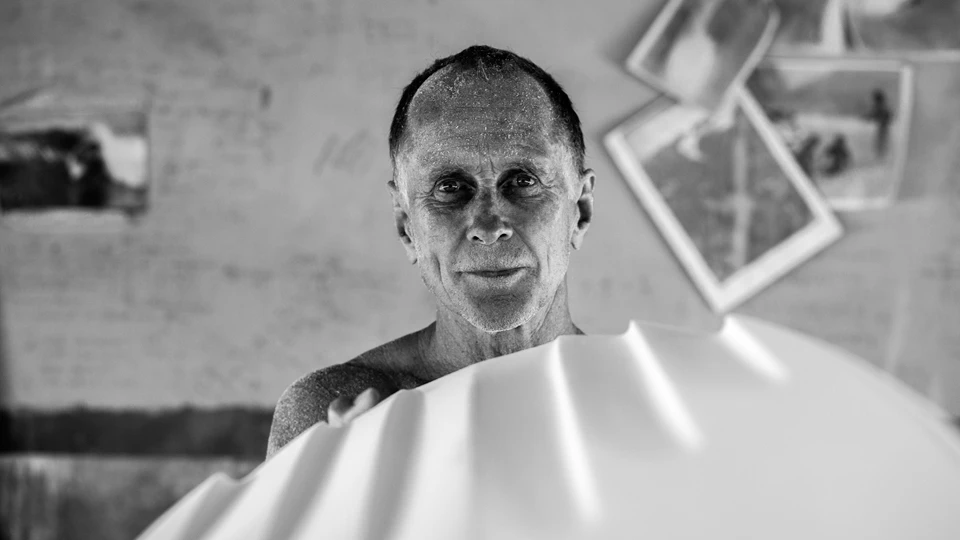
AB in his Gold Coast shaping bay Feb 2013. Photo: Azad Sellars
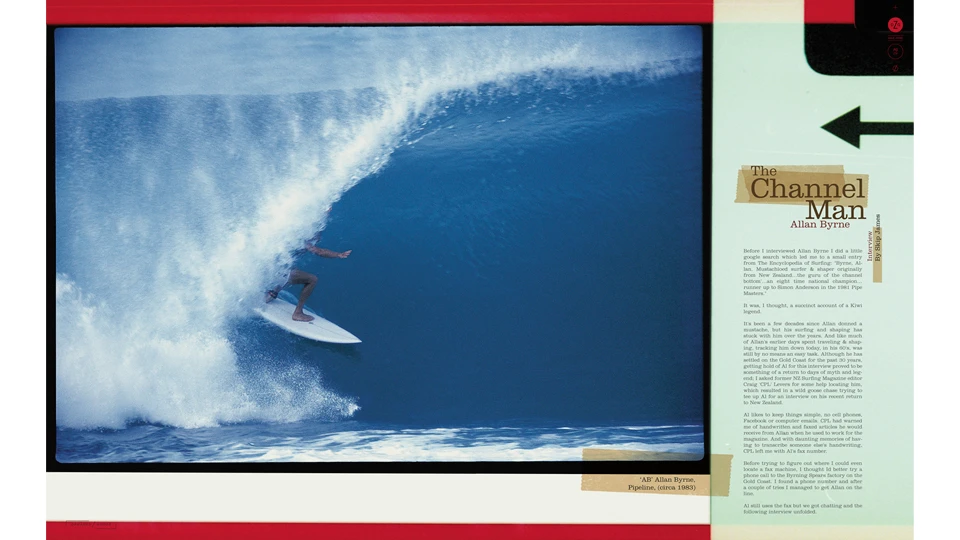
AB interview DGZ issue 03
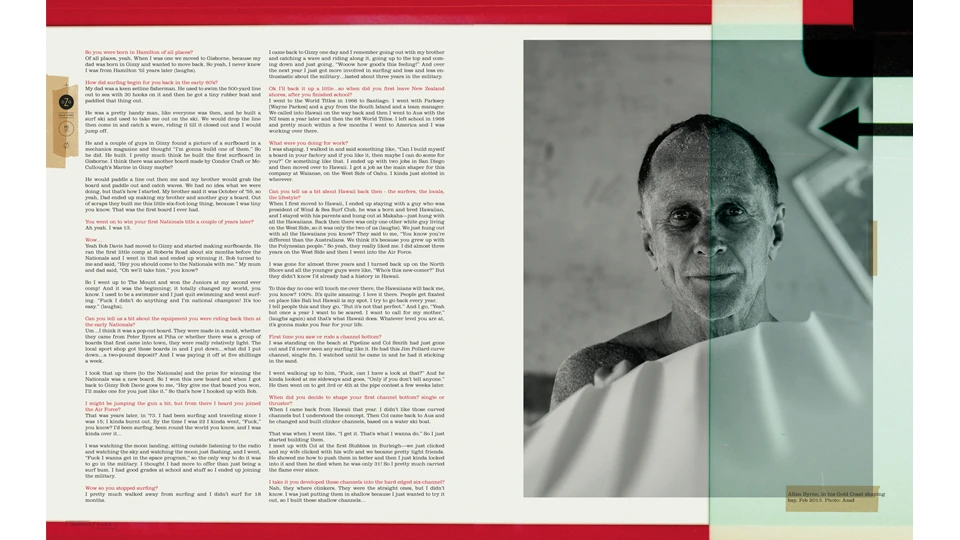
AB interview DGZ issue 03
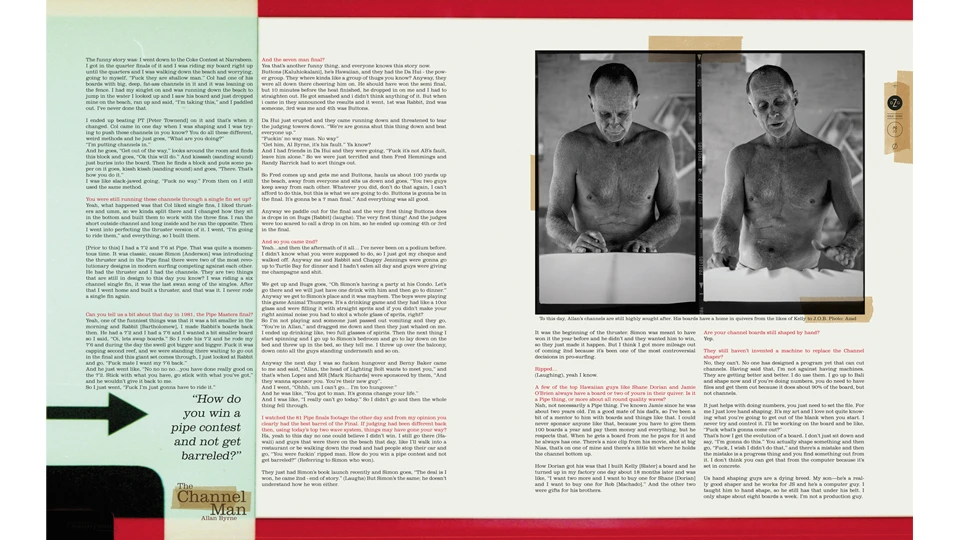
AB interview DGZ issue 03
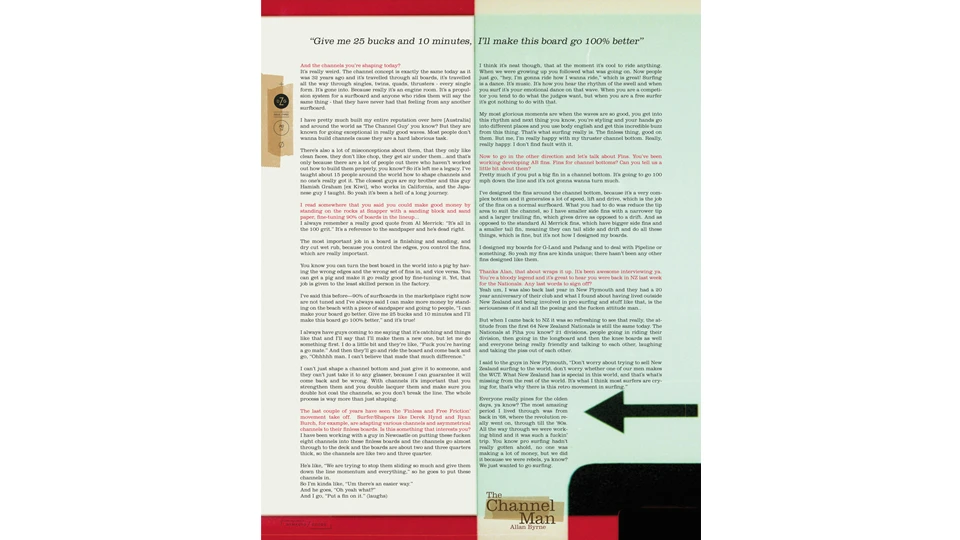
AB interview DGZ issue 03
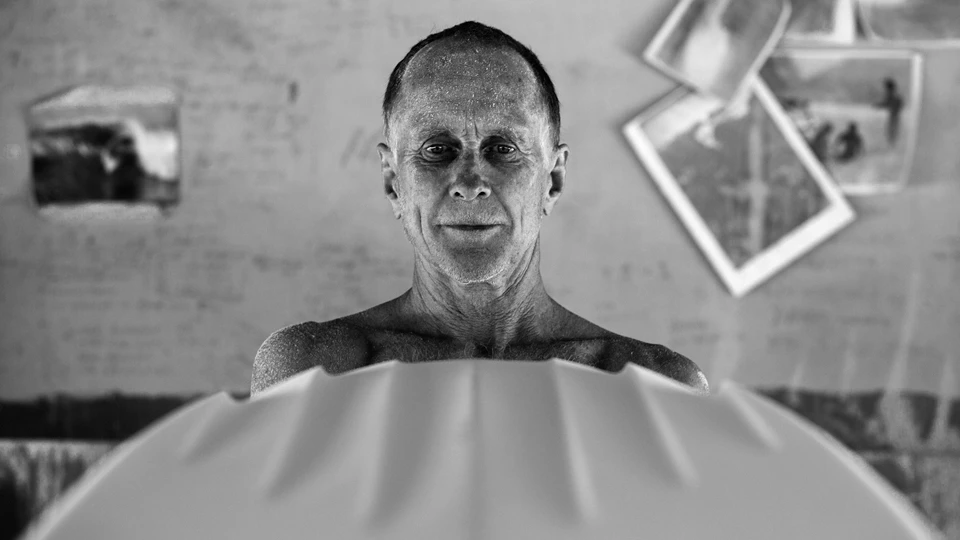
AB in his Gold Coast shaping bay Feb 2013. Photo: Azad Sellars
INTERVIEW BY JAMES SKIVINGTON
So you were born in Hamilton of all places?
Of all places, yeah. When I was one we moved to Gisborne, because my dad was born in Gizzy and wanted to move back. So yeah, I never knew I was from Hamilton ’til years later (laughs).
How did surfing begin for you back in the early 60’s?
My dad was a keen setline fisherman. He used to swim the 500-yard line out to sea with 30 hooks on it and then he got a tiny rubber boat and paddled that thing out.
He was a pretty handy man, like everyone was then, and he built a surf ski and used to take me out on the ski. We would drop the line then come in and catch a wave, riding it till it closed out and I would jump off.
He and a couple of guys in Gizzy found a picture of a surfboard in a mechanics magazine and thought “I’m gonna build one of them.” So he did. He built. I pretty much think he built the first surfboard in Gisborne. I think there was another board made by Condor Craft or McCullough’s Marine in Gizzy maybe?
He would paddle a line out then me and my brother would grab the board and paddle out and catch waves. We had no idea what we were doing, but that’s how I started. My brother said it was October of ’59, so yeah, Dad ended up making my brother and another guy a board. Out of scraps they built me this little six-foot-long thing, because I was tiny you know. That was the first board I ever had.
You went on to win your first Nationals title a couple of years later?
Ah yeah. I was 13.
Wow…
Yeah Bob Davie had moved to Gizzy and started making surfboards. He ran the first little comp at Roberts Road about six months before the Nationals and I went in that and ended up winning it. Bob turned to me and said, “Hey you should come to the Nationals with me.” My mum and dad said, “Oh we’ll take him,” you know?
So I went up to The Mount and won the Juniors at my second ever comp! And it was the beginning; it totally changed my world, you know. I used to be a swimmer and I just quit swimming and went surfing. “Fuck I didn’t do anything and I’m national champion! It’s too easy.” (laughs).
Can you tell us a bit about the equipment you were riding back then at the early Nationals?
Um…I think it was a pop-out board. They were made in a mold, whether they came from Peter Byers at Piha or whether there was a group of boards that first came into town, they were really relatively light. The local sport shop got these boards in and I put down…what did I put down…a two-pound deposit? And I was paying it off at five shillings a week.
I took that up there [to the Nationals] and the prize for winning the Nationals was a new board. So I won this new board and when I got back to Gizzy Bob Davie goes to me, “Hey give me that board you won, I’ll custom make one for you just like it.” So that’s how I hooked up with Bob.
I might be jumping the gun a bit, but from there I heard you joined the Air Force?
That was years later, in ’73. I had been surfing and traveling since I was 15; I kinda burnt out. By the time I was 22 I kinda went, “Fuck,” you know? I’d been surfing, been round the world you know, and I was kinda over it…
I was watching the moon landing, sitting outside listening to the radio and watching the sky and watching the moon just flashing, and I went, “Fuck I wanna get in the space program,” so the only way to do it was to go in the military. I thought I had more to offer than just being a surf bum. I had good grades at school and stuff so I ended up joining the military.
Wow so you stopped surfing?
I pretty much walked away from surfing and I didn’t surf for 18 months.
I came back to Gizzy one day and I remember going out with my brother and catching a wave and riding along it, going up to the top and coming down and just going, “Wooow how good’s this feeling!” And over the next year I just got more involved in surfing and less and less enthusiastic about the military…lasted about three years in the military.
Ok I’ll back it up a little…so when did you first leave New Zealand shores, after you finished school?
I went to the World Titles in 1966 to Santiago. I went with Parksey [Wayne Parkes] and a guy from the South Island and a team manager. We called into Hawaii on the way back and then I went to Aus with the NZ team a year later and then the 68 World Titles. I left school in 1968 and pretty much within a few months I went to America and I was working over there.
What were you doing for work?
I was shaping. I walked in and said something like, “Can I build myself a board in your factory and if you like it, then maybe I can do some for you?” Or something like that. I ended up with two jobs in San Diego and then moved over to Hawaii. I got a job as the main shaper for this company at Waianae, on the West Side of Oahu. I kinda just slotted in wherever.
Can you tell us a bit about Hawaii back then – the surfers, the locals, the lifestyle?
When I first moved to Hawaii, I ended up staying with a guy who was president of Wind & Sea Surf Club, he was a born and bred Hawaiian, and I stayed with his parents and hung out at Makaha—just hung with all the Hawaiians. Back then there was only one other white guy living on the West Side, so it was only the two of us (laughs). We just hung out with all the Hawaiians you know? They said to me, “You know you’re different than the Australians. We think it’s because you grew up with the Polynesian people.” So yeah, they really liked me. I did almost three years on the West Side and then I went into the Air Force.
I was gone for almost three years and I turned back up on the North Shore and all the younger guys were like, “Who’s this new-comer?” But they didn’t know I’d already had a history in Hawaii.
To this day no one will touch me over there, the Hawaiians will back me, you know? 100%. It’s quite amazing. I love it there. People get fixated on a place like Bali but Hawaii is my spot. I try to go back every year.
I tell people this and they go, “But it’s not that perfect.” And I go, “Yeah but once a year I want to be scared. I want to call for my mother,” (laughs again) and that’s what Hawaii does. Whatever level you are at, it’s gonna make you fear for your life.
First time you saw or rode a channel bottom?
I was standing on the beach at Pipeline and Col Smith had just gone out and I’d never seen any surfing like it. He had this Jim Pollard curve channel, single fin. I watched until he came in and he had it sticking in the sand.
I went walking up to him, “Fuck, can I have a look at that?” And he kinda looked at me sideways and goes, “Only if you don’t tell anyone.” He then went on to like 3rd or 4th at the pipe contest a few weeks later.
When did you decide to shape your first channel bottom and single or thruster?
When I came back from Hawaii that year. I didn’t like those curved channels but I understood the concept. Then Col came back to Aus and he changed and built clinker channels, based on a water ski boat.
That was when I went like, “I get it. That’s what I wanna do.” So I just started building them.
I meet up with Col at the first Stubbies in Burleigh—we just clicked and my wife clicked with his wife and we became pretty tight friends. He showed me how to push them in better and then I just kinda locked into it and then he died when he was only 31! So I pretty much I carried the flame ever since.
I take it you developed these channels into the hard edged six-channel?
Nah, they where clinkers. They were the straight ones, but I didn’t know. I was just putting them in shallow because I just wanted to try it out, so I built these shallow channels…
The funny story was: I went down to the Coke Contest at Narrabeen. I got in the quarter finals of it and I was riding my board right up until the quarters and I was walking down the beach and worrying, going to myself, “Fuck they are shallow man.” Col had one of his boards with big, deep, fat-ass channels in it and it was leaning on the fence. I had my singlet on and was running down the beach to jump in the water I looked up and I saw his board and just dropped mine on the beach, ran up and said, “I’m taking this,” and I paddled out. I’ve never done that.
I ended up beating PT [Peter Townend] on it and that’s when it changed. Col came in one day when I was shaping and I was trying to push these channels in you know? You do all these different, weird methods and he just goes, “What are you doing?”
“I’m putting channels in.”
And he goes, “Get out of the way,” looks around the room and finds this block and goes, “Ok this will do.” And kissssh (sanding sound) just buries into the board. Then he finds a block and puts some paper on it goes, kissh kissh (sanding sound) and goes, “There. That’s how you do it.”
I was like slack-jawed going, “Fuck no way.” From then on I still used the same method.
You were still running these channels through a single fin set up?
Yeah, what happened was that Col liked single fins, I liked thrusters and umm, so we kinda split there and I changed how they sit in the bottom and built them to work with the three fins. I ran the short outside channel and long inside and he ran the opposite. Then I went into perfecting the thruster version of it. I went, “I’m going to ride them,” and everything, so I built them.
[Prior to this] I had a 7’2 and 7’6 at Pipe. That was quite a momentous time. It was classic, cause Simon [Anderson] was introducing the thruster and in the Pipe final there were two of the most revolutionary designs in modern surfing competing against each other. He had the thruster and I had the channels. They are two things that are still in design to this day you know? I was riding a six channel single fin, it was the last swan song of the singles. After that I went home and built a thruster, and that was it. I never rode a single fin again.
Can you tell us a bit about that day in 1981, the Pipe Masters final?
Yeah, one of the funniest things was that it was a bit smaller in the morning and Rabbit [Bartholomew], I made Rabbit’s boards back then. He had a 7’2 and I had a 7’6 and I wanted a bit smaller board so I said, “Oi, lets swap boards.” So I rode his 7’2 and he rode my 7’6 and during the day the swell got bigger and bigger. Fuck it was capping second reef, and we were standing there waiting to go out in the final and this giant set comes through, I just looked at Rabbit and go, “Fuck mate I want my 7’6 back.”
And he just went like, “No no no no…you have done really good on the 7’2. Stick with what you have, go stick with what you’ve got,” and he wouldn’t give it back to me.
So I just went, “Fuck I’m just gonna have to ride it.”
And the seven man final?
Yea that’s another funny thing, and everyone knows this story now.
Buttons [Kaluhiokalani], he’s Hawaiian, and they had the Da Hui – the power group. They where kinda like a group of thugs you know? Anyway, they were all down there cheering him on. He should have won the semi final, but 10 minutes before the heat finished, he dropped in on me and I had to straighten out. He got smashed and i didn’t think anything of it. But when i came in they announced the results and it went, 1st was Rabbit, 2nd was someone, 3rd was me and 4th was Buttons.
Da Hui just erupted and they came running down and threatened to tear the judging towers down. “We’re are gonna shut this thing down and beat everyone up.”
“Fuckin’ no way man. No way”
“Get him, Al Byrne, it’s his fault.” Ya know?
And I had friends in Da Hui and they were going, “Fuck it’s not AB’s fault, leave him alone.” So we were just terrified and then Fred Hemmings and Randy Rarrick had to sort things out.
So Fred comes up and gets me and Buttons, hauls us about 100 yards up the beach, away from everyone and sits us down and goes, “You to guys keep away from each other. Whatever you did, don’t do that again, I can’t afford to do this, but this is what we are going to do. Buttons is gonna be in the final. It’s gonna be a 7 man final.” And everything was all good.
Anyway we paddle out for the final and the very first thing Buttons does is drops in on Bugs [Rabbit] (laughs). The very first thing! And the judges were too scared to call a drop in on him, so he ended up coming 4th or 3rd in the final.
And so you came 2nd?
Yeah…and then the aftermath of it all… I’ve never been on a podium before. I didn’t know what you were supposed to do, so I just got my cheque and walked off. Anyway me and Rabbit and Chappy Jennings were gonna go up to Turtle Bay for dinner and I hadn’t eaten all day and guys were giving me champagne and shit.
We get up and Bugs goes, “Oh Simon’s having a party at his Condo. Let’s go there and we will just have one drink with him and then go to dinner.” Anyway we get to Simon’s place and it was mayhem. The boys were playing this game Animal Thumpers. It’s a drinking game and they had like a 10oz glass and were filling it with straight sprits and if you didn’t make your right animal noise you had to skol a whole glass of sprits, right?
So I’m not playing and someone just passed out vomiting and they go, “You’re in Allan,” and dragged me down and then they just whaled on me. I ended up drinking like, two full glasses of sprits. Then the next thing I start spinning and I go up to Simon’s bedroom and go to lay down on the bed and threw up in the bed, so they tell me. I threw up over the balcony, down onto all the guys standing underneath and so on.
Anyway the next day I was so fucken hungover and Berny Baker came to me and said, “Allan, the head of Lighting Bolt wants to meet you,” and that’s when Lopez and MR [Mark Richards] were sponsored by them, “And they wanna sponsor you. You’re their new guy”.
And I went, “Ohhh, um I can’t go… I’m too hungover.”
And he was like, “You got to man. It’s gonna change your life.”
And I was like, “I really can’t go today.” So I didn’t go and then the whole thing fell through.
I watched the 81 Pipe finals footage the other day and from my opinion you clearly had the best barrel of the Final. If judging had of been different back then, using today’s top two wave system, things may have gone your way?
Ha, yeah to this day no one could believe I didn’t win. I still go there (Hawaii) and guys that were there on the beach that day, like I’ll walk into a restaurant or be walking down the road and had people stop their car and go, “You were fuckin’ ripped man. How do you win a pipe contest and not get barreled?” (Referring to Simon who won).
They just had Simon’s book launch recently and Simon goes, “The deal is I won, he came 2nd – end of story.” (Laughs) But Simon’s the same; he doesn’t understand how he won either.
It was the beginning of the thruster. Simon was meant to have won it the year before and he didn’t and they wanted him to win, so they just made it happen. But I think I got more mileage out of coming 2nd because it’s been one of the most controversial decisions in pro-surfing.
Ripped…
(Laughing), yeah I know.
A few of the top Hawaiian guys like Shane Dorian and Jamie O’Brien always have a board or two of yours in their quiver. Is it a Pipe thing, or more about all round quality waves?
Nah, not necessarily a Pipe thing. I’ve known Jamie since he was about two years old. I’m a good mate of his dad’s, so I’ve been a bit of a mentor to him with boards and things like that. I could never sponsor anyone like that, because you have to give them 100 boards a year and pay them money and everything, but he respects that. When he gets a board from me he pays for it and he always has one. There’s a nice clip from his movie, shot at big Nias, that’s on one of mine and there’s a little bit where he holds the channel bottom up.
How Dorian got his was that I built Kelly [Slater] a board and he turned up in my factory one day about 18 months later and was like, “I want two more and I want to buy one for Shane [Dorian] and I want to buy one for Rob [Machado].” And the other two were gifts for his brothers.
Are your channel boards still shaped by hand?
Yep.
They still haven’t invented a machine to replace the Channel shaper?
No, they can’t. No one has designed a program yet that can cut channels. Having said that, I’m not against having machines. They are getting better and better. I do use them. I go up to Bali and shape now and if you’re doing numbers, you do need to have files and get them cut because it does about 90% of the board, but not channels.
It just helps with doing numbers, you just need to set the file. For me I just love hand shaping. It’s my art and I love not quite knowing what you’re going to get out of the blank when you start. I never try and control it. I’ll be working on the board and be like, “Fuck what’s gonna come out?”
That’s how I get the evolution of a board. I don’t just sit down and say, “I’m gonna do this.” You actually shape something and then go, “Fuck, I wish I didn’t do that,” and there’s a mistake and then the mistake is a progress thing and you find something out from it. I don’t think you can get that from the computer because it’s set in concrete.
Us hand shaping guys are a dying breed. My son—he’s a really good shaper and he works for JS and he’s a computer guy. I taught him to hand shape, so he still has that under his belt. I only shape about eight boards a week I’m not a production guy.
And the channels you’re shaping today?
It’s really weird. The channel concept is exactly the same today as it was 32 years ago and it’s travelled through all boards, it’s travelled all the way through singles, twins, quads, thrusters – every single form. It’s gone into. Because really it’s an engine room. It’s a propulsion system for a surfboard and anyone who rides them will say the same thing – that they have never had that feeling from any another surfboard.
I have pretty much built my entire reputation over here [Australia] and around the world as ‘The Channel Guy’ you know? But they are known for going exceptional in really good waves. Most people don’t wanna build channels cause they are a hard laborious task.
There’s also a lot of misconceptions about them, that they only like clean faces, they don’t like chop, they get air under them…and that’s only because there are a lot of people out there who haven’t worked out how to build them properly, you know? So it’s left me a legacy. I’ve taught about 15 people around the world how to shape channels and no one’s really got it. The closest guys are my brother and this guy Hamish Graham [ex Kiwi], who works in California, and the Japanese guy I taught. So yeah it’s been a hell of a long journey.
I read somewhere that you said you could make good money by standing on the rocks at Snapper with a sanding block and sand paper, fine-tuning 90% of boards in the lineup.
I always remember a really good quote from Al Merrick: “It’s all in the 100 grit.” It’s a reference to the sandpaper and he’s dead right.
The most important job in a board is finishing and sanding, and dry cut wet rub, because you control the edges, you control the fins, which are really important.
You know you can turn the best board in the world into a pig by having the wrong edges and the wrong set of fins in, and vice versa. You can get a pig and make it go really good by fine-tuning it. Yet, that job is given to the least skilled person in the factory.
I’ve said this before—90% of surfboards in the marketplace right now are not tuned and I’ve always said I can make more money by standing on the beach with a piece of sandpaper and going to people, “I can make your board go better. Give me 25 bucks and 10 minutes and I’ll make this board go 100% better,” and it’s true!
I always have guys coming to me saying that it’s catching and things like that and ill say that I’ll make them a new one, but let me do something first. I do a little bit and they’re like, “Fuck you’re having a go mate.” And then they’ll go and ride the board and come back and go, “Ohhhhh man. I can’t believe that made that much difference.”
I can’t just shape a channel bottom and just give it to someone, and they can’t just take it to any glasser, because I can guarantee it will come back and be wrong. With channels it’s important that you strengthen them and you double lacquer them and make sure you double hot coat the channels, so you don’t break the line. The whole process is way more than just shaping.
The last couple of years have seen the ‘Finless and Free Friction’ movement take off. Surfer/Shapers like Derek Hynd and Ryan Burch, for example, are adapting various channels and asymmetrical channels to their finless boards. Is this something that interests you?
I have been working with a guy in Newcastle on putting these fucken eight channels into these finless boards and the channels go almost through to the deck and the boards are about two and three quarters thick, so the channels are like two and three quarter.
He’s like, “We are trying to stop them sliding so much and give them down the line momentum and everything,” so he goes to put these channels in.
So I’m kinda like, “Um there’s an easier way.”
And he goes, “Oh yeah what?”
And I go, “Put a fin on it.” (laughs)
I think it’s neat though, that at the moment it’s cool to ride anything. When we were growing up you followed what was going on. Now people just go, “hey, I’m gonna ride how I wanna ride,” which is great! Surfing is a dance. It’s music. It’s how you hear the rhythm of the swell and when you surf it’s your emotional dance on that wave. When you are a competitor you tend to do what the judges want, but when you are a free surfer it’s got nothing to do with that.
My most glorious moments are when the waves are so good, you get into this rhythm and next thing you know, you’re styling and your hands go into different places and you use body english and get this incredible buzz from this thing. That’s what surfing really is. The finless thing, good on them. But me, I’m really happy with my thruster channel bottom. Really, really happy. I don’t find fault with it.
Now to go in the other direction and let’s talk about Fins. You’ve been working developing AB fins. Fins for channel bottoms? Can you tell us a little bit about them?
Pretty much if you put a big fin in a channel bottom. It’s going to go 100 mph down the line and it’s not gonna wanna turn much.
I’ve designed the fins around the channel bottom, because it’s a very complex bottom and it generates a lot of speed, lift and drive, which is the job of the fins on a normal surfboard. What you had to do was reduce the tip area to suit the channel, so I have smaller side fins with a narrower tip and a larger trailing fin, which gives drive as opposed to a drift. And as opposed to the standard Al Merrick fins, which have bigger side fins and a smaller tail fin, meaning they can tail slide and drift and do all these things, which is fine, but it’s not how I designed my boards.
I designed my boards for G-Land and Padang and to deal with Pipeline or something. So yeah my fins are kinda unique; there hasn’t been any other fins designed like them.
Thanks Allan, that about wraps it up. It’s been awesome interviewing ya. You’re a bloody legend and it’s great to hear you were back in NZ last week for the Nationals. Any last words to sign off?
Yeah um, I was also back last year in New Plymouth and they had a 20 year anniversary of their club and what I found about having lived outside New Zealand and being involved in pro surfing and stuff like that, is the seriousness of it and all the posing and the fucken attitude man..
But when I came back to NZ it was so refreshing to see that really, the attitude from the first 64 New Zealand Nationals is still the same today. The Nationals at Piha you know? 21 divisions, people going in riding their division, then going in the longboard and then the knee boards as well and everyone being really friendly and talking to each other, laughing and taking the piss out of each other.
I said to the guys in New Plymouth, “Don’t worry about trying to sell New Zealand surfing to the world, don’t worry whether one of our men makes the WCT. What New Zealand has is special in this world, and that’s what’s missing from the rest of the world. It’s what I think most surfers are crying for, that’s why there is this retro movement in surfing.”
Everyone really pines for the olden days, ya know? The most amazing period I lived through was from back in ’68, where the revolution really went on, through till the ’80s. All the way through we were working blind and it was such a fuckin’ trip. You know pro surfing hadn’t really gotten ahold, no one was making a lot of money, but we did it because we were rebels, ya know? We just wanted to go surfing.